Dario Amodei has called for AI companies to slow the pace at which they improve frontier-model capabilities. Sam Altman and Elon Musk quickly supported the call, which produced the unusual sight of several competing AI leaders agreeing on something in public. The Financial Times covered the response.
It does raise a more practical question for those of us building with the models: what would a slower frontier mean for AI implementation inside companies?
End-user AI and background systems
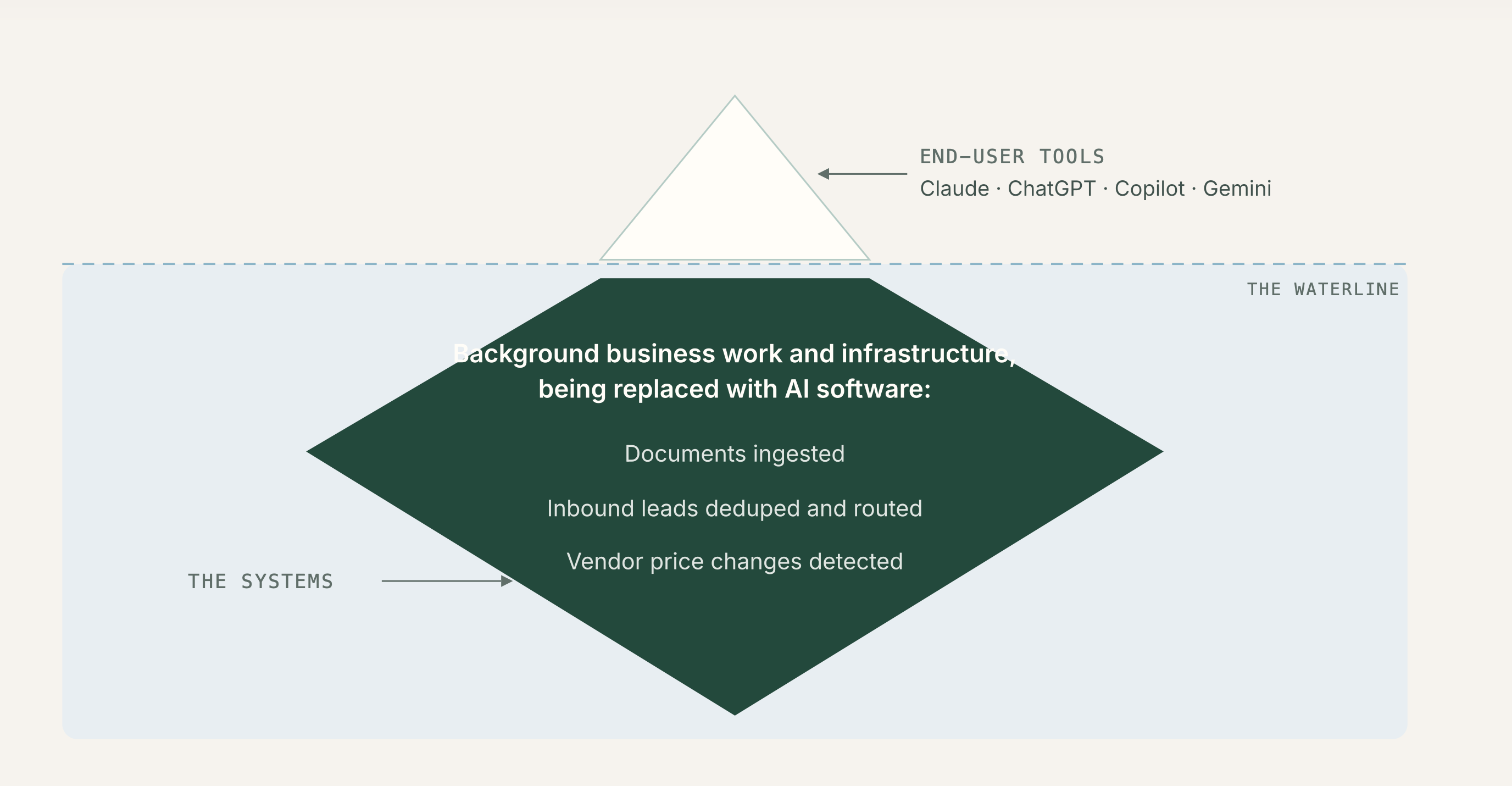
There are two types of AI applications emerging inside companies.
The first is end-user AI. Someone opens Claude, ChatGPT or Copilot and gives it a problem. The user supplies context, steers the work, corrects mistakes and decides when the result is useful. Frontier improvements have an obvious effect here. A more capable model lets the person attempt a larger problem with less direction. It can work across more context, recover from mistakes and choose a better path through work that was never fully defined.
Background systems work differently. They run a process the company already understands:
- Pull the inbound records.
- Ask the model one bounded question.
- Validate the answer.
- Update another system.
- Log what happened.
These systems use the same models, but they ask much less of them. A more capable model can make harder systems possible. But many of the transformations sitting in company backlogs do not require another leap in model intelligence. The required capability arrived years ago.
Our best systems run on older models
Some of the most valuable systems we have built first worked when Sonnet 3.5 was current.This was the original thinking behind Aisle’s workflow engine. We did not want a model considering the whole problem at once - instead we use chained model calls, breaking the problem down into a set of defined steps.
A programmer already works this way. A function should do one thing. It receives known inputs, performs its operation and returns something the next function can use. Giving a model one narrow judgment follows the same structure. This is what we often call deterministic AI.
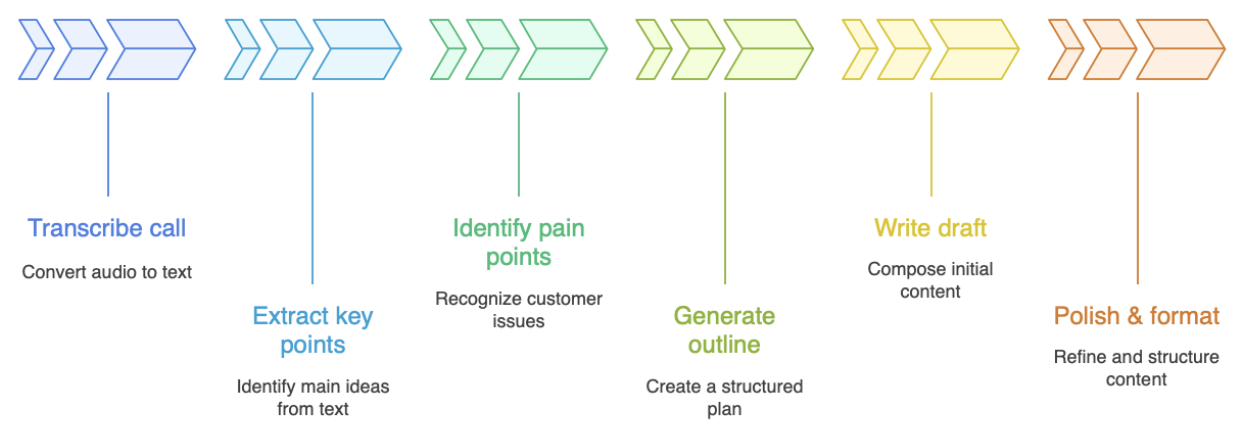
Taking this approach is what led us to build systems that are reliable and testable. Especially with earlier problems, with earlier models, they would typically not succeed if asked to focus on more than one thing at a time.
That distinction has become more important with every model release. The process is the asset. The model is one replaceable component inside it.
At scale, we use cheaper models anyway
New models normally enter through the hardest step in a system. Once the implementation scales, the pressure moves in the other direction. Once a system runs thousands of times, we are usually required move down the model curve
- Token burn and costs escalate quickly when the same model call runs thousands of times.
- Most companies are facing API rate limits.
- Keep frontier models on the small number of judgments that require them.
The newest Astra + Fable models are excellent. They are also an expensive way to extract five known fields from an invoice. A system that runs ten times a month can afford an expensive model almost anywhere. At ten thousand runs, every unnecessary model call becomes visible
More capability can also mean more reasoning than the operation needs. For end-user work, that extra reach is often the product. In a fixed process, it can add cost, latency and new behaviour to a step that was already solved.
The highest value systems do not change
A slower frontier would still leave companies with a large amount of useful work to do.
Most have barely started defining which processes should become systems. In all honesty most companies we talk to are still hyper-focused on the way they, as humans, are driving AI to generate PowerPoints to do research and are not thinking in the way their company becomes a system.
Very little to do with systems is waiting for the next model. The models already available can support more business transformation than companies have implemented. Frontier development may slow. The work of turning existing capability into systems does not have to.